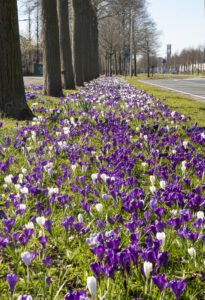
In spring and early summer, roadside verges and roundabouts planted with spring bulbs become colourful calling cards for municipalities. Mixing the right varieties creates a continuous flowering period of up to four to five months. This is how bulb flowers can enhance the quality of public spaces for people and animals.
Real eye-catchers!
Plants with striking colours, scents and shapes have been shown to positively affect people’s well-being and health. Thanks to their vibrant colours and variety of heights and shapes, bulb flowers are highly ornamental and valued inclusions in any planting plan. On roundabouts, they are often combined with perennials and shrubs. These floral roundabouts are real eye-catchers in the municipality.
Honey plants
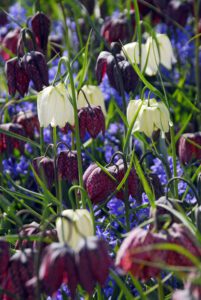
Naturalising bulbs, including Fritillaria meleagris (snake’s head fritillary), Narcissus (daffodil) and Chionodoxa (glory-of-the-snow), are ideal for combining with grass. With the focus on urban ecology, municipalities are increasingly choosing naturalising mixtures that also attract bees and butterflies. Crocus tommasinianus (early crocus), Allium (ornamental onion) and Muscari (grape hyacinth) are examples of good honey plants. In autumn, a machine is used to plant the bulbs under grass and then they emerge in all their glory in spring. Extensive maintenance of such verges is attractive for municipalities. They only need to be mowed a few weeks after flowering once the foliage has dried out. The bulbs will then have stored enough food to show-off again the following year.
Tips
Suppliers of flower bulbs offer bespoke advice tailored to a municipality’s location and requirements. Things to consider include mixing specific colours, flowering periods, heights and attractiveness to insects.
If a single-variety planting is desired, the flowering period can be extended by mixing different cultivars.