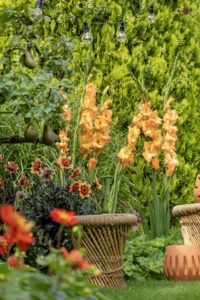
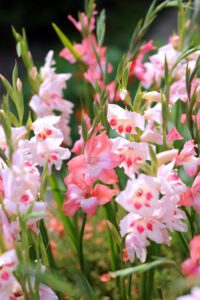
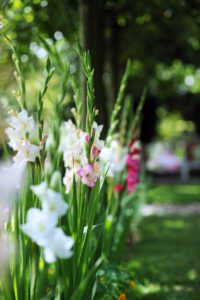
The gladiolus has been crowned summer bulb of the year. They should be planted in the spring, after the last frost. You’ll then be able to enjoy a sea of blooms in almost every colour later in the same year. Many also fill the air with a lovely scent. Bees and bumblebees love gladioli, so you can also contribute to a biodiverse and vibrant garden.
Many varieties
Gladioli symbolise pride, strength and victory. This flower’s Latin name is the diminutive of ‘gladius’, which means sword and is a reference to the sword-shaped leaf. It’s also known as the sword lily.
Most garden gladioli are originally from South Africa, where they are used as food. European botanists discovered this corm (a modified stem) in the 17th century. Crossbreeding has given rise to many varieties in all shapes and colours, some with multiple colours per flower. Special new gladioli are still appearing on the market.
Delightful fragrance
With hundreds of different varieties, the large-flowered group is the biggest. Most form stems over a metre long with dozens of flower buds on either side. From bottom to top, you see them unfurling one by one. Of particular note is the Abyssinian gladiolus (Gladiolus callianthus ‘Murielae’). The star-shaped flowers of this special variety are white with a burgundy centre and exude a lovely fragrance. Small-flowered gladioli bloom a little earlier and grow lower at 50 to 70 centimetres. Whichever gladiolus you choose, they are all gorgeous eye-catchers!
Tips for growing the prettiest gladioli
- Gladioli thrive in locations with well-drained soil that get at least 6 hours of sun per day.
- Create clusters, combine them with other summer bulbs or scatter them along the border.
- Create your own picking garden by planting generously and picking them when the first flowers open.
- To spread out the blooming times, plant several corms every other week through the end of June.
- Prune the spent flower stems completely, while leaving the leaves.
- You can also plant them in pots. The lower-growing varieties are particularly suitable for this.
- Water regularly during dry periods.